Roofing in Diamondhead, a 1970s resort that became a city in 2012
Diamondhead is unlike anywhere else we work. Laid out as a resort community in the 1970s, it only incorporated as a city in February 2012, and with 89.7 per cent owner-occupancy it has the highest proportion of owner-occupiers on our list by a clear margin.
A median build year of 1997 sits between the original 1970s resort lots and the post-Katrina rebuilding — the surge here reached close to thirty feet. The result is a town with three distinct generations of housing on winding, wooded streets laid out around golf and water rather than on a grid, which is why we route Diamondhead by neighbourhood rather than by address number.
The owner-occupancy figure drives the work. Nearly nine in ten households own, a large share are long-term residents, and the roofing consequence is that people here maintain rather than react. We do proportionally more planned inspection work in Diamondhead than anywhere else, more pre-emptive replacement before a roof actually fails, and less of the emergency work that defines our schedule in other towns. People ring in March about a roof they intend to replace in the autumn, which is a civilised way to run a roof.
The trees are the local variable. Diamondhead is genuinely wooded, which is part of its appeal and hard on roofs. Overhanging limbs abrade shingles and drop debris into valleys. Shaded north slopes stay damp and grow algae. And in a storm, limbs come down — Ida produced an EF1 tornado through Diamondhead and Pass Christian in 2021, and tree strike was a large share of the damage. Keeping limbs trimmed back from the roof plane is the single most effective thing most owners here can do.
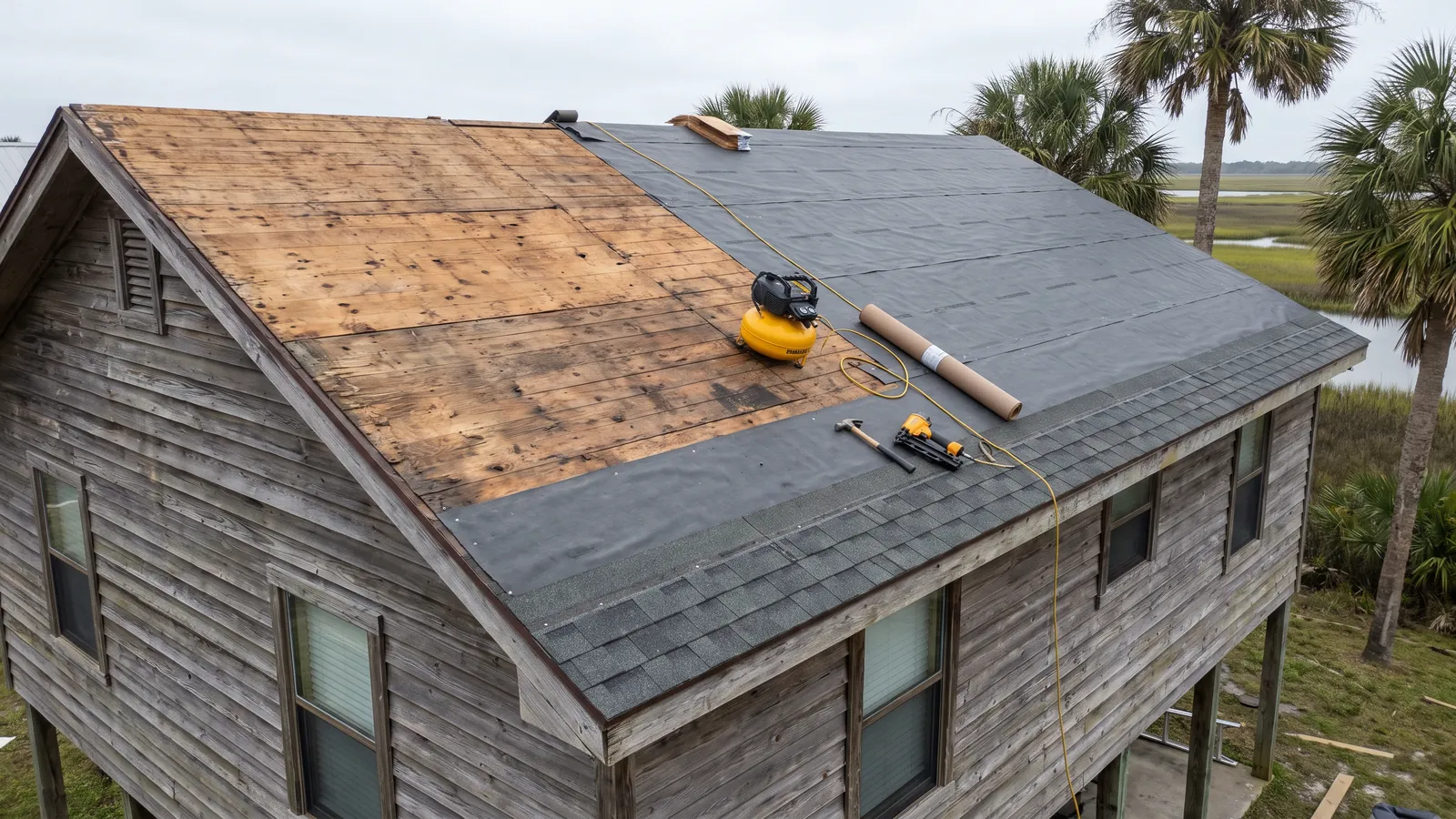
The 1970s original stock deserves a note of its own. Those roofs sit on structures built long before any coastal wind provision, and a tear-off on one typically reveals decking nailed to a light schedule with no edge detail worth the name. It is all correctable and it should be in the quote.
What we do in Diamondhead
Planned rather than reactive
A town that maintains, where most of our work is booked months ahead rather than after a failure.
Tree damage as the main hazard
Limb abrasion, debris in valleys, shaded growth and storm strike, all worse here than anywhere else we cover.
1970s decks brought up to standard
Original resort-era roofs predate any wind provision, and a tear-off is where that gets corrected.
Routed by neighbourhood
Winding wooded streets laid out around golf and water rather than a grid, so we plan by area.
Three housing generations
Original 1970s lots, 1990s infill and post-Katrina rebuild, each wanting a different approach.
Pre-emptive replacement supported
If you want to plan a roof for next autumn rather than react next storm, that is the easier and cheaper way round.
Neighbourhoods and roads we cover
- The original 1970s resort neighbourhoods
- Streets around the golf courses
- The wooded residential areas north of the interstate
- Properties near the bayou and water features
- 1990s and 2000s infill developments
- Post-Katrina rebuilt homes
- The approaches toward the Bay St. Louis boundary
- Community and commercial buildings
Roofing services in Diamondhead
- Roof repair, leak tracing, storm damage, emergency call-outs and tarping
- Full replacement, Class H shingle, metal roofing and FORTIFIED upgrades
- Inspections, insurance documentation and claim support
- Flat and low-slope, commercial, gutters and soffit and fascia
Questions from Diamondhead homeowners
How much damage do the trees actually do?
More than most people credit. Limbs moving in wind abrade shingle granules away at the contact point, debris packs valleys and gutters so water backs up under the courses, and shaded slopes stay damp enough to grow algae. Then in a storm the limb itself comes down. Trimming back from the roof plane addresses all four.
My house is original to the 1970s. What is under the shingles?
Typically decking fastened to a light schedule and essentially no edge detail, because neither was required when it was built. Possibly a second layer. None of that is unusual for the era and all of it is correctable during a tear-off — it just needs to be quoted rather than found.
I want to plan a replacement rather than wait for a failure. Is that sensible?
It is much the better way round, and more Diamondhead owners do it than anywhere else we work. You choose the season, you get a proper choice of materials and dates, you avoid the post-storm queue, and nobody is making decisions with water coming through a ceiling.
What happened here in Ida?
An EF1 tornado went through Diamondhead and Pass Christian in August 2021. Tree strike was a large part of the damage, which in a wooded town is the characteristic hazard — a roof that would have handled the wind perfectly well does not handle an oak limb landing on it.
Does the FORTIFIED grant apply here?
Hancock County is one of the six named counties in the Strengthen Mississippi Homes programme, with the condition that the home is in a jurisdiction enforcing a code that meets FORTIFIED. Diamondhead only incorporated in 2012, so it is worth confirming the current position — the guide covers what to check.
Nearby: Bay St. Louis · Waveland · Pass Christian · full service area